
Our History
In 2024, We’re Celebrating 100 Years of Excellence in Engineering at Duke
-
Our lineage can be traced to the 19th century institutions that became Duke University.
Jump to Section -
Our modern birth came when J.B. Duke’s foresighted philanthropy transformed Trinity College into Duke University in 1924.
Jump to Section -
J.B. Duke’s vision takes real form when university trustees establish the College of Engineering.
Jump to Section -
Major changes arrive with end of World War II. The College of Engineering moves into its first purpose-built home—the elegant Engineering Building.
Jump to Section -
Duke’s national and global leadership in biomedical engineering is established.
Jump to Section -
In the 1980s and ’90s, the School of Engineering grows and develops with new facilities, becomes the home of the first NSF Engineering Research Center on biomedical research, and gains an endowment.
Jump to Section -
At the turn of the century, the accelerating speed of the organization is palpable. Evidence includes the opening of the 125,000-square-foot Fitzpatrick Center, which vastly expands research space in photonics, nanotechnologies and biomedical engineering.
Jump to Section -
As the Pratt School of Engineering becomes one of the fastest-rising engineering schools in the country, it sets sights on making major positive impacts, nationally and globally.
Jump to Section
Origins
-
1851-1923
The earliest record is an 1851 advertisement by Normal College in Randolph County, North Carolina, for a course including classical engineering. After funding by the Methodist Church, the institution is renamed Trinity College. By 1887, Trinity offers courses in civil engineering and mining engineering. Seeking expansion only an urban setting could provide, Trinity College moves to Durham, NC, in 1892.
Duke University is Born
-
1924

caption Industrialist and philanthropist James B. Duke signs the Indenture of Trust that tranforms Trinity College into Duke University. He charges the caretakers of the new institution to “uplift mankind” through teaching and research on subjects that “develop our resources, increase our wisdom and promote human happiness.” Duke specifies that the trustees establish “an Engineering School, as and when funds are available.”
-
1927

caption Departments for civil engineering and electrical engineering are established.
Engineering is quartered on the Trinity campus. Classes and labs meet in the Asbury (pictured) and Bivins buildings. Engineering students live in “The Shack”—Southgate Hall.
-
1930s
The annual student-led Engineers Show becomes a popular event at Duke and in Durham. Technological marvels are displayed—including television, new forms of artificial lighting and “The Mystifier,” a machine which reveals a person’s height and weight.
-
1931

caption The Department of Mechanical Engineering is established. Total engineering student enrollment exceeds 100.
-
1937
The engineering enterprise at Duke covers 30,000 square feet—six times greater than just a decade earlier. Enrollment exceeds 160 engineering students.
A College of Engineering is Founded
-
1939
The College of Engineering is formed, the third undergraduate college at the young university. Civil engineer William H. Hall, a 1907 alumnus and a faculty member since 1915, is the first dean. The engineering student body grows to 201. Five new professors nearly double the engineering faculty to 12.
-
1940

caption The first issue of The Duke Engineer appears. The student-written magazine is renamed DukEngineer in 1941 and is published annually.
-
1943
The College of Engineering holds its first commencement exercises early, on April 12. Members of the inaugural class go into a variety of wartime efforts.
-
1946

caption Electrical engineers Muriel Theodorsen Williams (left) and Marie Foote Reel (right) are the Duke College of Engineering’s first female graduates.
Reel graduates magna cum laude, and later works as engineering instructor at Texas A&M University and as chief specifications engineer for DeLeuw Cather, design consultants for the DC Metro.
Williams interrupts physics training at Duke to be one of 100 in a wartime engineering training program for women at Rensselaer Polytechnic Institute. At the war’s end, she returns to Duke and graduates from the School of Engineering. Later she works as a consultant in the calibration of precision tools.
Postwar Expansion
-
1948

caption The College of Engineering moves to West Campus, taking up residence in the new red-brick Engineering Building.
-
1951

caption North Carolina lawmakers pass an important early anti-pollution law. William Brewster Snow, a 1932 Duke graduate, member of the engineering faculty and a leading sanitation engineer, founds a series of conferences that guide implementation of the new Stream Sanitation Law.
-
1957
The College of Engineering offers the first Master of Science degrees available at Duke.
-
1960
Duke is the first private institution in the Southeast to offer a PhD in electrical engineering.
-
1963

caption Gene R. Kendall is the first Black undergraduate engineering student and one of The First Five undergraduates to integrate Duke.
Kendall leaves Duke in his sophomore year to study at the University of Kansas, where he completes bachelor’s and master’s engineering degrees and Navy Nuclear Power Training. At Kansas, Kendall is integral in establishing the Student Council for Recruiting, Motivating and Educating Black Engineers. He serves in the Navy for 35 years, rising to the rank of rear admiral.
-
1964
Duke begins offering a PhD in civil engineering.
Rise to Prominence
-
1966
In “recognition of its professional status and of the stature that it had achieved in its programs of graduate study and research,” Duke’s trustees elevate the college to the School of Engineering.
-
1967

caption Mechanical engineering student C.B. Claiborne starts for the Blue Devils. He is the first Black player on the Duke men’s basketball team and scores 13 points in his debut, a win against Penn State. At Duke he is not spared the institutionalized racism of the era—including not receiving his varsity letter at the team’s awards banquet, which is held at a segregated country club.
Following graduation, Claiborne works for Westinghouse, Ford, Duke Power and Booz-Allen, earns advanced degrees from Dartmouth, Washington University in St. Louis, and Virginia Tech, and becomes a widely-published and award-winning scholar, educator and photographer.
-
1967

caption Durham’s Herald-Sun informs readers that Duke’s new Division of Biomedical Engineering is founded “to train people for a new profession which requires more knowledge about medicine than is possessed by the average engineer and more knowledge in engineering than is possessed by the average doctor.” (Pictured, left to right, William Anlyan, James Meriam and Theo Pilkington)
-
1968

caption The first Black students graduate from the Duke School of Engineering: mechanical engineer Alfred J. Hooks (left), civil engineer Kenneth Spaulding Chestnut (right), and electrical engineer Charles Hall.
Hooks works for Caterpillar for 40 years, is active in public service in Peoria, Ill., and earns a pilot’s license. Chestnut rises as a leader in the global construction industry, later retiring as president and CEO of IBG Construction Services.
-
1971

caption Biomedical Engineering becomes a full academic department at Duke—a first at an American university. In 1972, Duke is the first to offer an accredited undergraduate major in biomedical engineering.
-
1976

caption Frederick L. “Fritz” Thurstone and graduate student Olaf von Ramm lay the foundation for the phased-array imaging system that will revolutionize cardiac imaging—paving the way for real-time ultrasound imaging in clinical practice.
Accelerating Growth and Development
-
1984

caption - The Nello L. Teer Engineering Library opens (pictured). The naming honors the Durham construction executive, who provided $1.5 million
- A four-decade relationship with the LORD Corporation begins with a gift of $40 million to promote cross-disciplinary research, support excellence in teaching and foster hands-on student projects
-
1985

caption Henry Petroski of Duke CEE publishes To Engineer Is Human: The Role of Failure in Successful Design, the first of a shelf of critically acclaimed books from “America’s poet laureate of technology.”
-
1987

caption - Olaf von Ramm and Stephen Smith invent the first real-time 3-D ultrasonic scanner (pictured), now used worldwide in multiple specialties
- The CEE department establishes a certificate in architectural engineering
- The Center for Emerging Cardiovascular Technology becomes the first National Science Foundation (NSF) Engineering Research Center (ERC) focused on biomedical engineering
-
1989
Duke Engineering launches a NSF Research Experiences for Undergraduates (REU) program, offering authentic summer laboratory opportunities to students from across the United States. The Duke REU program is a national model.
-
1990

caption - Ray Ideker, with William Smith and Patrick Wolf (pictured, at right) of Duke BME optimize biphasic waveforms for defibrillation of the heart.
- Earl H. Dowell, Kenneth Hall and a Duke MEMS team demonstrate an innovative method of modeling complex, time-varying fluid flows much more efficiently and compactly than ever before—opening new possibilities for understanding and controlling such flows. The insights improve the efficiency and safety of airframes and power turbines.
-
1991

caption - Electrical engineer Blake S. Wilson, a 1974 graduate and a Duke faculty member, develops the continuous interleaved sampling processing strategy for the cochlear implant (pictured), which bestows the sense of hearing to the profoundly deaf
- Duke BME’s Howard G. Clark and Duke cardiologist Richard Stack patent the first bio-absorbable stent.
-
1992
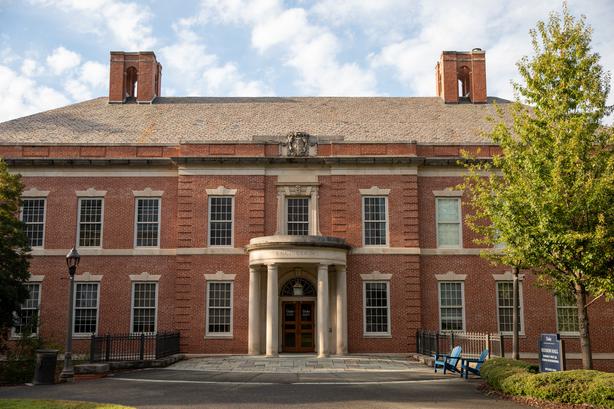
caption The Engineering Building is named for Fitzgerald S. “Jerry” Hudson, Class of 1946—the first engineering graduate to chair Duke’s trustees.
-
1994
The Levine Science Research Center opens, providing vast new space for the growing engineering school and allied Duke research programs.
-
1996

caption Adrian Bejan of Duke MEMS postulates the constructal law of design.
-
1997
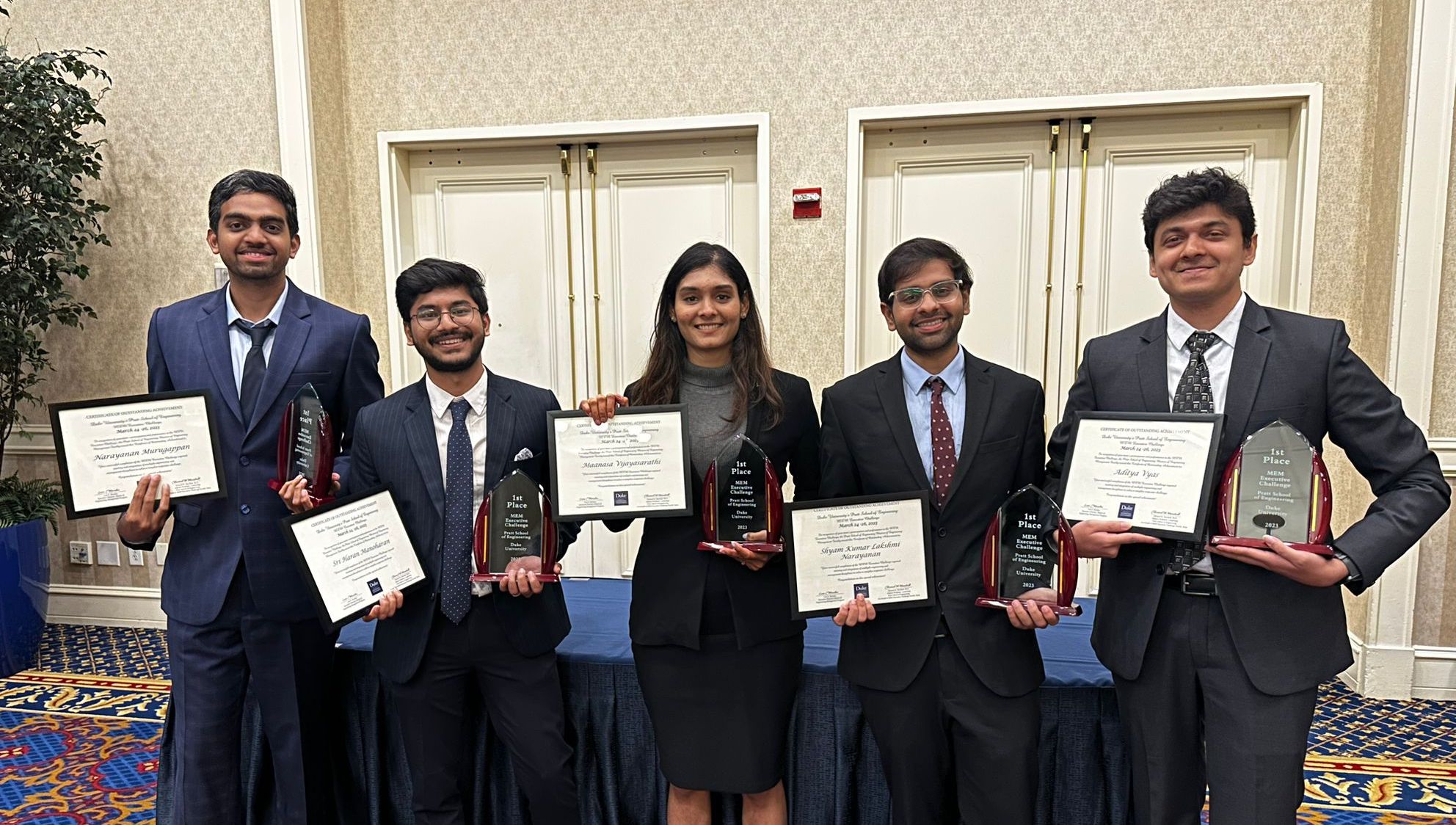
caption With 12 students, Duke launches the Master of Engineering Management. Within 15 years, the program is educating nearly 300 students in technical and business subjects.
-
1998

caption Biomedical engineer Wanda Krassowska Neu is the first female faculty member to receive tenure in the School of Engineering. Her work focuses on electroporation-mediated drug and gene delivery, and a nonlinear dynamics approach to cardiac arrhythmias.
-
1999

caption - Kristina M. Johnson (pictured) becomes dean of engineering at Duke—the first female to hold the role
- The school is named for Edmund T. Pratt Jr., Class of 1947, in recognition of his philanthropy and service. The pharmaceutical executive endows the school with a $35 million gift
- Ashutosh Chilkoti (BME) develops the first elastin-like polypeptide fusion that provides a new method to purify proteins without chromatography—opening a new path to developing drugs with greater potency and fewer side effects
Ready for Impact in the 21st Century
-
2000

caption A $25 million gift by Michael J. Fitzpatrick, Class of 1970, and Patty Wyngaarden Fitzpatrick, Class of 1969, establishes the Fitzpatrick Institute for Photonics to explore innovation through light-based technologies.
-
2002

caption - The Pratt Undergraduate Research Fellowships are launched, providing unique opportunities for undergraduates to engage in authentic research with faculty
- Gregg Trahey and Kathryn Nightingale of Duke BME (pictured) demonstrate a new ultrasound device that allows clinicians to detect and diagnose ailments such as liver scarring and prostate cancer without having to make an incision.
-
2003

caption - Joseph Izatt (pictured) and his Duke BME medical imaging research group demonstrate a more than 100-fold improvement in the sensitivity of optical coherence tomography (OCT)
- Lawrence Carin, Leslie Collins and fellow Duke ECE researchers develop data-processing techniques that safely detect hidden landmines. The techniques are adopted by U.S armed forces
- In a breakthrough with significant implications for the development of prostheses for paralyzed patients, Miguel Nicolelis, Craig Henriquez and the Duke Center for Neuro-Engineering team demonstrate that the reaching and grasping of a robotic arm can be controlled by brain signals alone.
-
2004
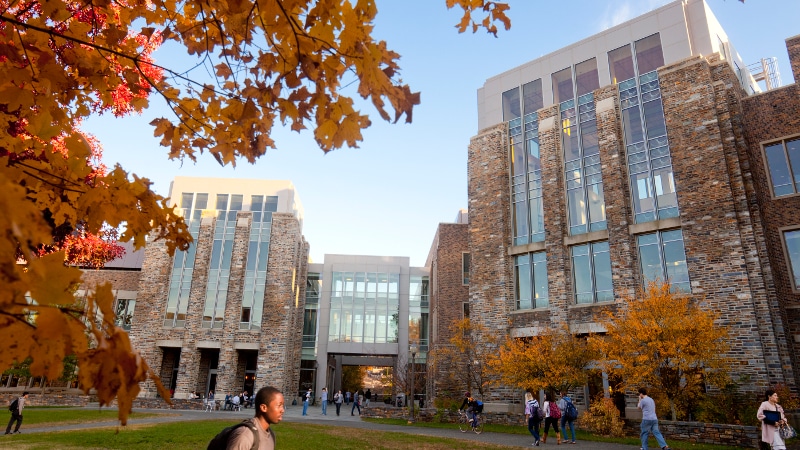
caption The immense Center for Interdisciplinary Engineering, Medicine and Applied Sciences opens. Duke’s trustees name it in honor of Duke graduates and philanthropists Michael and Patty Fitzpatrick.
-
2005
- The Duke-Coulter Translational Partnership is launched to promote the development of new technologies that improve patient care
- Major expansion of the undergraduate class begins, with the goal of total enrollment of 1,200 by 2009.
- A Duke Engineering collaboration with Effat University leads to the founding of the School of Engineering for Women in Jeddah, Saudi Arabia.
-
2006

caption - With support from the Duke-Coulter Translational Partnership, Duke BME’s Nimmi Ramanujam (pictured) brings to market a novel instrument that uses light waves to detect cancer and assess treatment effectiveness in real time.
- The metamaterials revolution begins as David R. Smith of Duke ECE and collaborator John Pendry of Imperial College, London introduce “transformation optics”—an innovation suggesting the possibility of invisibility cloaks and other exotic structures.
-
2007

caption - The 11,400-square-foot Shared Materials Instrumentation Facility (SMiF) opens in the Fitzpatrick Center, providing a state-of-the-science cleanroom facility and resources for the characterization, fabrication and imaging of nanotechnologies
- The Duke Smart Home opens on Faber Street in Durham. The 6,000-square-foot facility is a live-in laboratory of automation and sustainability technologies for 10 undergraduate students. In 2008, it is awarded LEED Platinum certification, the first in the world for a university residence hall.
-
2008
- Duke CEE’s Mark Wiesner is chosen to lead a $14.4-million federal project exploring the potential hazards of nanoparticles. In 2013, NSF renews the grant for $15 million.
- The Center for Metamaterials and Integrated Plasmonics launches. In 2009, it wins a $6.25-million grant from the Army Research Office
- Lingchong You and Duke BME colleagues engineer a synthetic predator-prey ecosystem using gene circuits—one of the most influential studies in the new field of synthetic biology
-
2009

caption - Duke takes a leadership role in creating the National Academy of Engineering Grand Challenge Scholars Program, which ties student study and research to one of the NAE’s identified must-do tasks for humanity in the 21st century. The program begun at Duke and its partners is replicated at more than 50 U.S. engineering schools.
- LaTondra Murray (pictured, center) and the master’s education team expand professional graduate options at Duke with the launch of the Master of Engineering Management Online.
-
2010
- Duke trustees approve the career-focused Master of Engineering, which combines training in technical and business subjects. The first MEng students arrive in the fall
- A partnership with North Carolina State University launches the Grand Challenge K-12 Partners Program to stimulate interest in science and technology among young students
- Duke engineers lead two major federally-funded research programs: $24.8 million MOSAIC (Maximally scalable Optical Senor Array Imaging with Computation) and $15 million MUSIQC (Modular Universal Scalable Ion-trap Quantum Computer)
- Duke CEE’s Mark Wiesner and CEINT researchers idemonstrate that nanomaterials accumulate in living organisms
-
2012

caption - Jeffrey N., Class of 1981, and Penny Vinik establish a $10 million challenge fund to recruit and retain faculty focused on complex societal challenges. The school’s senior leadership role is named the Vinik Dean of Engineering
- PhD Plus launches—one of the country’s first programs offering professional development training for engineering doctoral students
- Students working with global-health engineer Bob Malkin develop the Pratt Pouch (pictured)—a delivery packet that increases access to antiretroviral drugs, thereby lowering transmission of HIV between mother and newborn
- David Brady of Duke ECE leads development of the world’s first gigapixel camera, which captures images in unprecedented detail
-
2013
- The first U.S. implantation of a bioengineered blood vessel is performed at Duke University Medical Center. The vessel is based on bioreactor technology developed by Duke anesthesiologist and biomedical engineer Laura Niklason
- Duke wins highly competitive national defense grants—$8.6 million to develop predictive modeling for new materials development and $7.5 million for a project in acoustic metamaterials.
- Led by Nimmi Ramanujam, the Global Women’s Health Technologies Center is founded as a partnership between the Pratt School of Engineering and Duke Global Health Institute
- An undergraduate major in environmental engineering and a minor in energy engineering debut
-
2014

caption - The Pratt School of Engineering community celebrates 75 years
- Steven Cummer and a Duke ECE team demonstrate the first three-dimensional acoustic cloaking device (research scientist Bogdan Popa is pictured), which uses metamaterials to reroute sound waves
Engineering in Service to Society
-
2015
- Representing more than a quarter of U.S. engineering schools, Dean Thomas C. Katsouleas and peers present a message to President Obama setting a goal of graduating more than 20,000 specially trained Grand Challenge engineers by 2025
-
2016

caption Duke is awarded $31.9 million from the Intelligence Advanced Research Projects Activity to advance quantum computing through an extensible universial reconfigurable ion trap. The new multi-institution project is named EURIQA.
-
2017

caption Under the leadership of education innovator Ann Saterbak, Duke’s First-Year Design Experience launches in a new maker space, the Design Pod.
-
2018

caption - The National Science Foundation awards Duke $15 million to lead STAQ, a seven-university consortium focused on building the first practical quantum computer
- The student-led Duke Electric Vehicles club sets the Guinness World Record for Most Fuel-Efficient Vehicle (pictured)—an amazing 14,573 mpg equivalent.
-
2019

caption - Duke Engineering’s four-decade relationship with the LORD Corporation culminates with a $261 million distribution to support education and research at the engineering school and provide financial aid for Duke undergraduates. It is the largest single contribution to the university since J.B Duke’s founding endowment in 1924
- As part of Duke’s all-hands response to the COVID-19 pandemic, the MEDx partnership between Duke’s schools of engineering and medicine supports clinicians with innovations to overcome shortages and other complications. Projects include retrofit kits that increase the number of powered air respirators (pictured) and a device for safely transporting infected patients.
-
2020
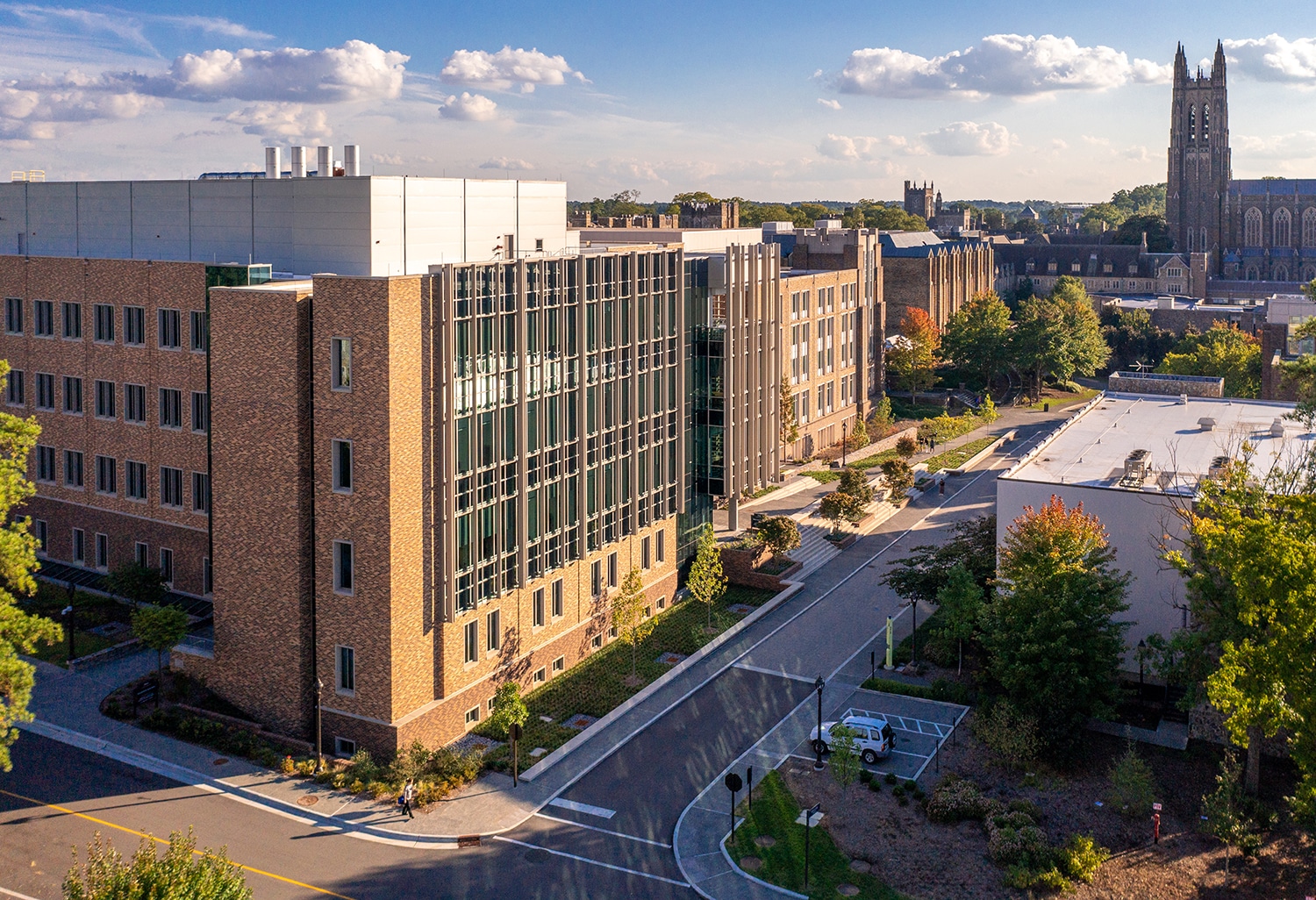
caption The innovative 81,000-square-foot Wilkinson Building opens. Public health restrictions delay the start of classes there until January 2021. The building’s name recognizes the philanthropy and service of 1967 graduate Jerry C. Wilkinson, spouse Beverly A. Wilkinson, and their family.
-
2022

caption - Civil engineer Jerome P. Lynch becomes the Vinik Dean of Engineering.
- The National Science Foundation selects Duke and environmental engineer Claudia Gunsch (pictured, center) to lead the Engineering Research Center for Precision Microbiome Engineering, focused on creating technologies that address challenges at the interface of human health and the built environment. Partners include NC Agricultural & Technical State University, NC State University, UNC-Chapel Hill and UNC-Charlotte.
-
2023

caption ODE at Duke, or Outreach Design Education, begins under the leadership of biomedical engineer Aaron Kyle.
Through thoughtful engagements, including a Design Hackathon, Summer Design Camp for highschoolers and a professional development for K-12 teachers, ODE enhances community access to STEM resources, fosters inclusivity and builds strong local partnerships.