Pratt Facilities

The Fitzpatrick Center for Interdisciplinary Engineering, Medicine and Applied Sciences

The Fitzpatrick Center

The Fitzpatrick Center for Interdisciplinary Engineering, Medicine and Applied Sciences (FCIEMAS) is designed to position the Pratt School and its partners to make major advancements in the fields of bioengineering, photonics, materials science and environmental engineering. It  supports specialized initiatives that drive interdisciplinary activities, and encourages the creative interactions essential for making significant progress in these fields. Students working in the Fitzpatrick Center learn that major advances occur at the boundaries between disciplines.

This comprehensive facility provides extensive wet bench laboratories, departmental offices, teaching labs, and other lab support spaces, and direct access to the café. A highlight is a state-of-the-art clean room for nanotechnology research. The center’s carefully designed interaction spaces and proximity to the Medical Center and colleagues in photonics and materials engineering foster highly productive collaborative projects. The center is also the home of Pratt's computational resources.

FCIEMAS is also home to the Fitzpatrick Institute for Photonics, a highly interdisciplinary, collaborative research and educational program that integrates Duke's strengths in photonics research. The program focuses on cutting-edge research areas, such as biophotonics, nano/microsystems, nanophotonics, quantum optics & information photonics, which are uniquely suited to address the challenges and fulfill the promises of the next technology revolution at the nexus of the nano-bio-info-opto convergence.

The Home Depot Smart Home at Duke

The Home Depot Smart Home at Duke University is a 6,000 square foot live-in research laboratory operated by Duke's Pratt School of Engineering. The Home Depot Smart Home, part of a Duke Smart Home Program, creates a dynamic "living laboratory" environment that contributes to the innovation and demonstration of future residential building technology.

The central concept of this project is our belief that smart homes can improve the quality of life for people of all ages and incomes. Inherent in our goal to create 'smart homes' is the idea that 'smart technology' means using the best technology to solve a particular problem - which doesn't necessarily mean high-tech gadgetry. Simple, practical things like citing the dorm with a southern facing, capturing rainwater to use to flush toilets and utilizing solar energy to heat water are great solutions for typical homeowners.

Other universities already have smart homes, so why did we build another one at Duke? One of the most important aspects of this project is that it is a living laboratory. Students actually reside in The Home Depot Smart Home and live with the benefits and consequences of their technology design and deployment decisions. This up close and personal approach to technology development will have a profound impact on our students - and on industry as Pratt engineers graduate and launch their own careers.

DUhatch

DUhatchDUhatch is an undergraduate business incubator. Our educational goal is to connect enterprising students with mentors from faculty and industry, giving them office space and facilitating business development to help solve the myriad problems a fledgling venture faces. DUhatch helps to turn innovative ideas into innovative businesses and social ventures. Entrepreneurship is an area where the most learning occurs through doing, and DUhatch is intended to provide this vital experiential component to complement the wide range of entrepreneurship support (curricular and cocurricular) that the university offers.

DUhatch, located in the Teer building, has private office space allocated to six early stage ventures. Space is granted from one to four years (renewable yearly), provided at least one team member is a Duke student at all times. Additional ventures will be granted access to DUhatch facilities as space allows. DUhatch residents work together to promote the success of each other's ventures. Residents are expected to demonstrate leadership in actively engaging and supporting entrepreneurial activities across the campus.

This focus on students and education sets DUhatch apart from most commercial business accelerators. The aim of the DUhatch student business incubator is to educate and to make entrepreneurship a more integral part of the Duke experience. In this regard, DUhatch is envisioned as a truly multidisciplinary effort that brings together diverse areas of campus, including technology, business, law, and medicine. 


Shared Materials Instrumentation Facility

The Shared Materials Instrumentation Facility (SMIF) at Duke University operates as an interdisciplinary shared-use facility. It offers researchers with high-quality and cost-effective access to advanced materials characterization and fabrication capabilities. It was established in 2002 as part of the University’s Materials Initiative with funding from the Provost’s office and is located in the Fitzpatrick Center for Interdisciplinary Engineering, Medicine and Applied Sciences. SMIF consists of an Instrumentation Laboratory for the characterization and analysis of materials and a Fabrication Laboratory for the fabrication of devices and micro/nanostructures.

SMIF is available to Duke University researchers from the various schools and departments as well as to “external” users from other universities, government laboratories, or industry. Hourly-based user fees are charged as a means of recovering the direct costs associated with operating the facility.

In addition to being a tremendous resource for researchers, SMIF also supports graduate and undergraduate research and education. Several undergraduate-level courses have been taught in the facility, and students involved in independent research projects such as the Pratt Undergraduate Research Fellows program also routinely benefit from the SMIF facility.

Duke Immersive Virtual Environment (DiVE)

The Duke Immersive Virtual Environment (DiVE) is a 6-sided cave-like virtual reality theater. It is the ideal system for fully immersive simulation and cognitive studies, and for verifying 3D structure between data models and experimental data. Projects currently planned for this Visroom include research in cognitive neuroscience, exploration of 3D structures, and education.

As the data sets scientists collect increase in size and complexity, so increases the need for ever more powerful tools to support data analysis and scientific communication. The tools that in the past have proved most useful in this regard have been those that take advantage of the remarkable information-processing ability built into human perceptual systems, particularly vision and audition. Thus, investigators in many of the most innovative fields of research - e.g., proteomics, genomics, seismology, neuroscience and astrophysics - rely heavily on computationally-intensive visualization tools to explore their data and test models.

Technologies such as the DiVE are used not only to explore data collected through other means but also as experimental tools in and of themselves. In addition, the DiVE has been used extensively as an interdisciplinary teaching tool at Duke, with student projects encompassing students from computer science, art, history and more all working together to create virtual worlds.


Hudson Hall

Hudson Hall

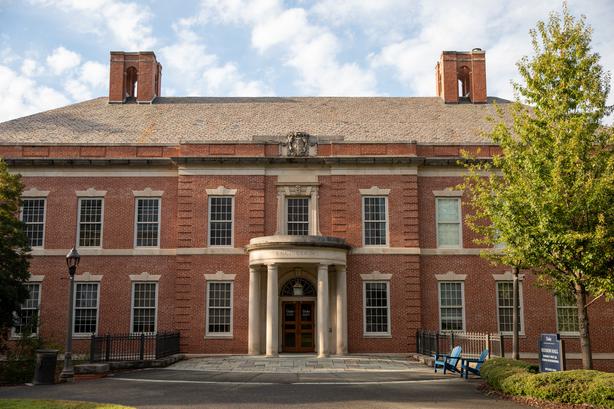
Hudson Hall is the oldest of the buildings in the engineering complex. It was built in 1948 when the Engineering School moved to Duke's West Campus and was known as "Old Red." (Incidentally, a red brick from Hudson Hall was incorporated into a facing wall of the Fitzpatrick Center in 2004 to symbolically tie the two facilities together.) An annex was built onto the back of the building in 1972, and in 1992 the building was expanded again and renamed Hudson Hall to honor Fitzgerald S. "Jerry" Hudson (E'46).

Hudson Hall is home to all four departments in the Pratt School of Engineering: biomedical engineering, civil & environmental engineering, electrical & computer engineering, and mechanical engineering & materials science. Hudson Hall houses some of the school's laboratories and teaching classrooms, and offices.

In addition, the facility includes a wind tunnel for aerodynamics research and two research centers: the Center for the Environmental Implications of Nanotechnology (CEINT) and the Gendell Center for Engineering, Energy and the Environment. CEINT is a $14 million Nanotechnology Initiative effort funded by the National Science Foundation and the Environmental Protection Agency. 


Teer Building

Teer Building

The Nello L. Teer Engineering Building opened in 1984, originally as a centralized library for engineering, math and physics. It is located next to Hudson Hall, separated by an azalea-filled courtyard and a walkway. The basement includes teaching laboratories, and the first floor features a general laboratory, a 50-seat auditorium, conference room, and librarian’s office. It is also home to the Engineering Student Government office, student clubs, the DukEngineer editorial team, and provides a well-trafficked student lounge/study area and computer lab.

The second floor features three large general-purpose project laboratories like those on the first floor as well as an information commons, telepresence suite, seminar rooms and the DUHatch undergraduate business incubator.

The third floor of Teer features the Dean's Office, a student services suite, Pratt's first year student coordinator, and academic deans, and the school's alumni relations team. 

The fourth floor of Teer features offices, the Pratt IT Help Desk, and an ultrasound-focused research suite.


LSRC - B Wing

Levine Science Research Center (LSRC)

The Levine Science Research Center (LSRC), named for Leon Levine, the CEO of Family Dollar Stores, is a 341,000-square-foot facility located behind Hudson Hall that was opened in 1994. The LSRC is a multipurpose facility housing classrooms, student labs and the Love Family Auditorium. The building is shared by the Nicholas School of the Environment and Earth Sciences, Pratt School of Engineering, Department of Pharmacology, the Molecular Cancer Biology group, our NSF-Engineering Research Center, the Cell and Molecular Biology group, the Center for Macromolecular Structure, Center for Cellular and Biosurface Engineering, and the Center for Cognitive Neuroscience.

When LSRC opened, Duke hailed it as a paradigm shift in how universities coordinate academics, research, and administration. Not only does the LSRC enhance laboratory space, faculty offices and teaching facilities campus-wide but it fosters collaboration between researchers from a variety of disciplines and cooperation between administrative units.

Questions about this page? Contact:

Deborah Hill, Director of Communications, 415 Teer Engineering Building, 919-660-8403, dahill@duke.edu